Compare with:
Saturn V
110.6m
Human (1.8m)
1.8m
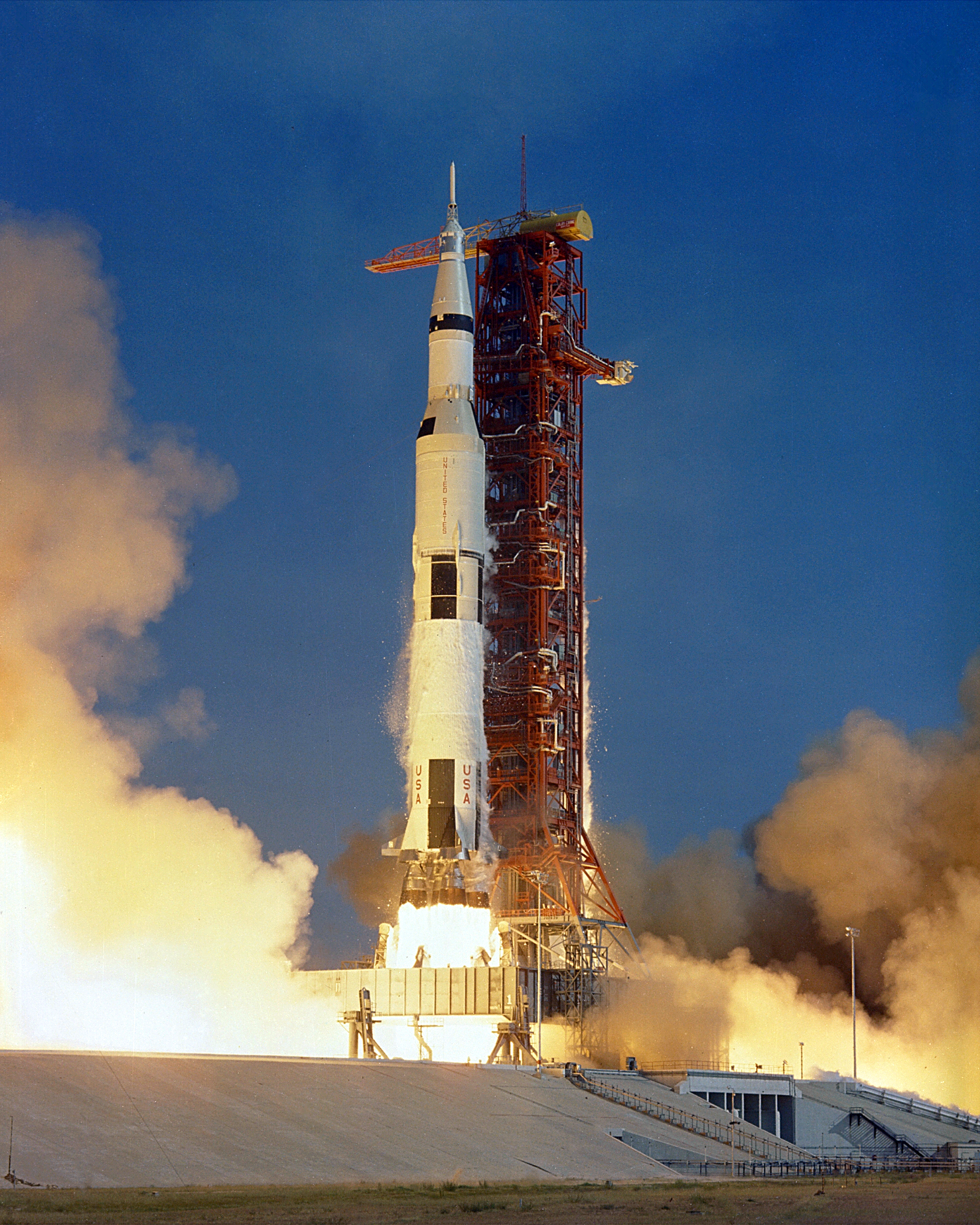
Saturn V / Credits: Wikipedia (Wikimedia Commons)
United StatesRetired Crewed1967–1973
Saturn V
NASA / Boeing / North American
The legendary American super heavy-lift rocket that carried astronauts to the Moon during the Apollo program.
Developed under Wernher von Braun at the Marshall Space Flight Center, the Saturn V remains the only launch vehicle to have carried humans beyond low Earth orbit. Its first stage, the S-IC, was powered by five F-1 engines burning RP-1 and liquid oxygen — together the most powerful set of liquid-propellant engines ever flown. Saturn V flew 13 times between 1967 and 1973 with a perfect record of delivering its crews safely, even during the near-disaster of Apollo 13. Its final flight launched the Skylab space station.
Fun facts
Each F-1 engine burned ~2,500 kg of propellant per second — more than an entire car weighs.
Saturn V was taller than the Statue of Liberty including its pedestal (93 m).
Apollo 13 was the only mission that returned without landing on the Moon — the crew survived by using the LEM as a lifeboat.
Height
110.6 m
Diameter
10.1 m
Mass
2,970 t
Stages
3
Thrust
35,100 kN
Payload LEO
140,000 kg
Payload GTO
48,600 kg
Total flights
13
Success rate96.2%
12 success1 partial0 failure
Launch pads
- LC-39A, Kennedy Space Center
- LC-39B, Kennedy Space Center









Leaflet © OpenStreetMap contributors
No upcoming launches scheduled.

